svu I woke from a coma just in time to hear my son, Diego, whisper to his sister: “As soon as he’s gone, we’ll send the old woman to a nursing home.”
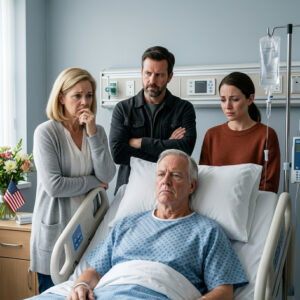
I woke from the coma on a Tuesday, and the first thing I saw was my wife’s face.
Later, Lucía would tell me exactly when it happened, because Lucía is precise in the ways that matter and has always believed that truth deserves proper boundaries. Tuesday, she said. Four forty-seven in the afternoon. Not around five. Not late in the day. Four forty-seven, because she had been staring at the clock above the hospital door the way people stare at clocks when there is nothing left to do but wait and measure their fear against time. My fingers twitched first. She felt it before she saw it. She called the nurse before I had even opened my eyes.
I remember light. Voices. The sting of antiseptic in the air. The dry, metallic taste in my mouth. A machine beeping steadily somewhere nearby. I remember feeling as though I had been dropped into the middle of a story without the beginning, and everyone else in the room already knew how the earlier pages had gone. Most of all, I remember Lucía leaning so close I could see the raw red burst of broken blood vessels in her eyes and the shine of tears she had been swallowing for so long they seemed to have changed the shape of her face.
There are moments in a long marriage when love reveals itself with the force of a new fact, even though you have known it for years. That was one of them. I had been somewhere very far away, and she had remained where I left her, waiting.
I did not understand anything else that first day. Not how long I had been unconscious. Not what had happened. Not why my right arm felt as though it belonged to a man sleeping in another room. Not why each attempt at speech seemed to drag over stones somewhere inside my chest. The doctors came and went. Nurses asked questions. Lucía answered most of them because I could not. Our children came in and stood beside the bed with appropriate expressions and careful voices, and I looked at them through a fog that seemed at first purely medical.
It was only over the next two days that I realized the fog held something else.
Memory, when it returns from darkness, does not always return as narrative. Sometimes it arrives as sound. Tone. One sentence with no place to sit until another sentence appears and locks against it. A phrase. A number. The rhythm of a voice you have known all your life speaking as if you are no longer there.
That is what happened to me.
I had heard them.
Not after I woke up. Before. While my eyes were closed, my body still, my mouth useless, and everyone around me assumed consciousness had gone entirely offline, some part of me had remained open. I do not know what science calls it. I do not care. I know only that I was there, trapped beneath silence, and their words entered me with perfect clarity.
The first fragment that returned was my daughter’s voice.
The market’s favorable right now. If we wait too long, the return drops.
There was no context yet. Only her voice, practical and clean, the voice she uses with clients and spreadsheets and all the careful architectures of financial advice that have made her successful. Graciela has always spoken as though disorder could be defeated if one were disciplined enough. Even as a child, she did not ramble. She arranged.
The second fragment was my son.
I know a guy who just sold a similar property two streets over. He can move fast.
And then, as my mind kept climbing back into itself, the rest came.
The house.
Our house.
The house Lucía and I bought twenty-eight years earlier after looking at sixteen others and rejecting all of them for reasons that ranged from mold to vulgarity to, in one case, a staircase that made no architectural sense at all. The house where both our children grew up. The house with the narrow front hall and the high shelves in the study and the kitchen window that catches the last gold light of the day in winter. The house with the lemon tree that should not, by all logic, still be alive after that hard freeze seven years ago but is, because Lucía wrapped the trunk in old blankets and went out three times that night with kettles of warm water as though she were tending a feverish child.
That house.
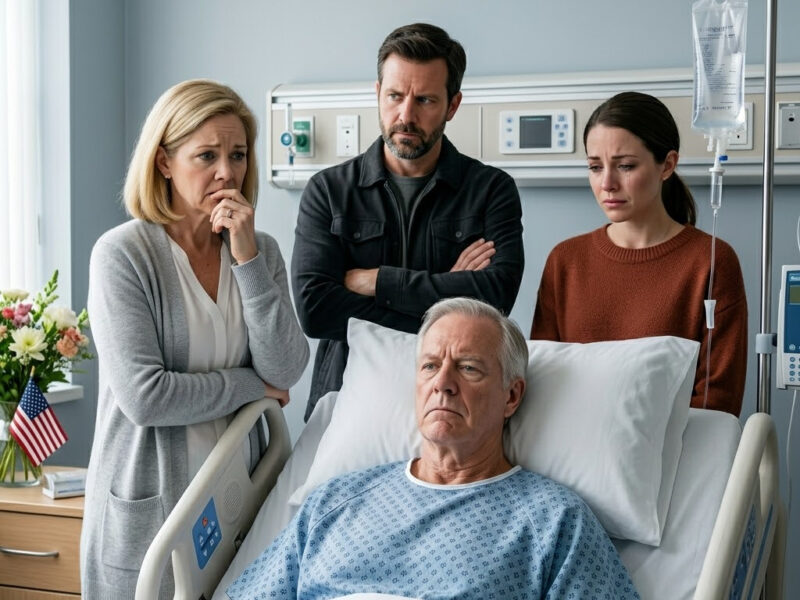
They were discussing its sale beside my hospital bed while I lay unconscious.
I remembered it in layers. First the subject, then the words around it, then the terrible composure with which the conversation had unfolded. There had been no argument, no shock, no grief-ravaged panic. Only logistics.
Diego mentioned the neighborhood. Comparable values. Timing. A real estate contact. Graciela said the market window was good and that clearing the property quickly would avoid “drawn-out complications.” At some point one of them used the phrase “liquidating the house,” which did not sound like a family member speaking about a home. It sounded like someone dealing with a line item in an estate file.
And then they spoke about Lucía.
My wife. My Lucía, who had slept in hospital chairs and forgotten meals and cried only in bathrooms or parking lots where she thought no one would see. Lucía, who had remained beside me through forty-three years of marriages and recessions and fevers and funerals and the thousand ordinary exhausted loyalties that build a life much more surely than romance ever does. Lucía, who has never in her life belonged in any institution more managed than a public library.
They discussed where to put her.
Not whether she wanted anything. Not whether she was capable. Not whether I would wake and continue to be her husband in the home we built together. They discussed assisted living the way people discuss parking options. Efficiently. Practically. Cost-conscious but not sentimental. Graciela knew a facility. One of her clients had moved a parent there. Good reputation, she said. Reasonably priced. Diego said the house would fund it and likely leave a clean remainder once “the situation resolved itself.”
The situation.
I was the situation.
Even now, months later, writing this down, I have to stop when I remember that phrase. There are injuries that arrive not in the wound itself but in the language surrounding it. My children did not say, “If Papa dies.” They did not say, “If he doesn’t come back.” They wrapped my possible disappearance in administration. The situation resolves itself. As if my life were weather. As if my marriage were a storage problem. As if my wife’s future and my home and the sum of what we built together existed to be optimized once I was no longer in a position to inconvenience them by continuing to live.
I am seventy-one years old. My name is Martín Alvarez. I have been married to Lucía for forty-three years. We built an import business from almost nothing, sold it for enough to live well but not foolishly, paid off a house, put two children through good schools, and thought for most of our lives that the essential work had been done. We were not grand people. We were careful people. We did not mistake extravagance for success. We believed in paying on time, repairing what could be repaired, and setting a table properly even on ordinary Tuesdays. We believed—this was perhaps our one great stupidity—that love and example together would teach our children how to see the world.
Perhaps they did. Only not in the way we imagined.
Diego is forty-four. He runs a construction management firm, speaks well in meetings, and has always known how to occupy a room with confidence just this side of arrogance. As a boy, he could charm teachers out of consequences and neighbors into lending him tools he never returned on time. There was brightness in him from the beginning, and also appetite. We mistook appetite for drive, as many parents do when the child resembles the culture’s definition of success closely enough.
Graciela is forty-one. She is elegant, disciplined, professionally respected, the kind of woman who remembers birthdays but also remembers tax deadlines and expiry dates and the names of her clients’ children. As a child she lined her dolls up by category and corrected other children’s grammar. As a woman she became a financial planner, which suited her perfectly. She is not greedy in the obvious ways. She is much more dangerous than that. She believes control is virtue.
For most of their adult lives, Lucía and I thought our relationship with them was reasonably good. Busy, yes. Less intimate than when they were young. Structured more around holidays, birthdays, grandchildren, and the occasional weekend than around deep conversation. But good enough. We were proud of them in the way parents are proud when their children appear competent and stable in the world. We did not look too closely at what lay beneath their competence because, if I am honest, we were relieved that they had landed on their feet. Relief can blind you almost as effectively as denial.
Now I wonder how long they had been looking at us and seeing assets.
The stroke happened on a Friday afternoon in March.
I remember the garden. I remember the bird in the olive tree. I remember kneeling beside the rosemary bed to pull a weed I had ignored the day before. Then the world tilted—not metaphorically, physically. One side of the sky folded. The ground came up badly and too quickly, and then there was the sensation of falling without any memory of impact. After that, nothing until Lucía’s face on Tuesday at four forty-seven.
Except, of course, that it was not nothing.
When the memories returned, they came with such force that I felt physically ill. The neurologist said that post-coma recall can be unpredictable. Lucía sat beside my bed while I tried to decide whether what I remembered was real or some grotesque dream stitched together by a damaged brain. The certainty grew with each fragment. Diego mentioning the sale. Graciela bringing a folder. My daughter’s voice discussing my insurance paperwork. Someone opening drawers in the bedside table Lucía had brought from home so I would have familiar things near me. A rustle of papers. Diego saying, “We need the full picture.” Graciela answering, “We can sort the accounts later. The important thing is not to leave Mamá with decisions she can’t manage.”
Lucía.
They were already removing decisions from her while she was still sleeping in a plastic chair two feet away.
On the fifth evening after I woke, when the nurses had dimmed the hallway lights and our children had gone home wearing their well-practiced concern, I told my wife what I had heard.
Speaking still cost me then. Each sentence took concentration. My tongue felt slow, disobedient. Lucía sat very straight in the chair beside the bed and listened without interrupting, though once or twice I saw her fingers curl inward against her palm the way they do when she is forcing herself not to react too soon.
I kept my eyes on the window while I spoke because I could not bear to watch her face as I gave her our children’s words back in detail.
I told her about the house. About Diego’s contact. About the market timing. About the assisted living facility one of Graciela’s clients had used. About the bedside table, the paperwork, the folder. About the phrase once the situation resolves itself.
By the time I finished, night had fully taken the window, and the hospital glass showed only our reflections—the old man in the bed, pale and diminished, and the woman beside him who looked as though someone had reached into her chest and rearranged vital organs with one clean motion.
She did not cry. That would have been easier. Lucía comes from people who lived through hard times by going silent before they went soft.
“How long,” she said after a while, “do you think they’ve been like this?”
It was the worst question because it had no answer I could offer that would not hurt her more.
“I don’t know.”
She sat still a moment longer, then reached out and put her hand over mine.
“All right,” she said quietly. “Then now we know.”
That is one of the reasons I have loved her for forty-three years. Not because she is fearless. Lucía is not fearless. She feels everything. But because when the truth arrives, even if it shatters something, she steps toward it rather than away.
The call to Ernesto happened the next morning while Lucía was out in the corridor speaking to the nurse about medication.
Ernesto Salvatierra has been my lawyer for nearly thirty years and my friend for almost as long. He is seventy-three, lean, careful, perpetually underimpressed by drama, and the kind of man who makes chaos shrink simply by entering it with a legal pad. We started as client and counsel when he helped me structure the business sale. Somewhere between the contracts and the years, he became family in the ways that matter more than blood sometimes does.
He answered on the second ring.
“Martín?”
“I need to disappear.”
There was a pause. Not a confused pause. A measuring one.
“From the hospital?”
“Yes.”
“Is this medical or personal?”
“Yes,” I said, and he understood at once that the distinction had ceased to be useful.
He did not waste time asking for explanations that could wait. “Can you travel?”
“The doctor says with care, yes.”
“When?”
“As soon as possible.”
“I’ll come before dawn tomorrow.”
I closed my eyes after that and let the phone rest against my chest. The exertion of the call had exhausted me, but beneath the exhaustion was a steadying I had not felt since waking. Action has that effect. Not always comfort. Not peace. But direction.
Later that afternoon, I told Dr. Fernández I wanted a transfer.
She was younger than my children, maybe thirty-five, with the dry voice and attentive eyes of a physician who has learned to separate urgency from noise. She looked at me for a long moment after I explained that I was medically stable enough to leave and did not wish to disclose the destination to my family.
“Are you in danger?” she asked.
“Not physically.”
She nodded as if that meant something specific to her, which perhaps it did. Hospitals teach people things about families.
“Your recovery would be better in a controlled, quiet environment with proper support,” she said. “If you have that, I’ll authorize the transfer.”
Lucía came in as we were finishing, and I saw the question in her eyes. Dr. Fernández glanced between us, then began writing the orders.
“Get some sleep,” she said. “You’ll need it.”
Sleep did not come easily that night.
Hospitals at night are a particular kind of half-world. Lights dimmed but never gone, footsteps passing, distant carts rattling, machines keeping their own implacable time. Lucía slept in the chair with her head at an impossible angle, and I watched the room and thought about the children sleeping in their own houses, certain of the architecture of things to come. I wondered if they had already spoken to realtors. I wondered if Graciela had, in fact, made the first quiet inquiries about elder placement. I wondered whether any of it had felt shameful while they were doing it.
And because I am not innocent of my own mind, I also wondered where, exactly, we had failed.
Parenthood has the indecency of lasting even when authority does not. You can know your children have behaved monstrously and still search yourself for the point of origin. Was it the trust fund distributions too early? The soft landings we provided? The endless benefit of the doubt? The fact that Lucía and I made life look manageable by doing so much unseen work they never fully understood what anything cost? Did we teach them generosity as performance instead of sacrifice as practice? Or were they simply themselves in ways no training could have permanently prevented?
I still do not know.
At five the next morning, Ernesto arrived in the dark with his old Volvo.
A nurse helped me into a wheelchair. Another handed Lucía a paper bag with medications and printed instructions and looked at us with the expression of someone who has decided not to ask questions she will not like the answers to. Dr. Fernández came by in her coat on her way out of the night shift and squeezed my shoulder once.
“Recover well,” she said.
“Thank you.”
Lucía rode in the back with me. She held my hand the entire drive.
The city was barely awake when we left it behind. At that hour the highways belonged to truckers and insomniacs and people fleeing situations they did not want to explain. The first pale line of dawn came up slowly behind the low industrial buildings at the outskirts, and then the land began to open. Fields. Small towns. Long roads with no urgency in them. The farther we went, the more my body seemed to understand that something vital had changed.
Ernesto’s house sat in a valley three and a half hours north of the city, among low hills and stands of eucalyptus and old agricultural land that had never entirely agreed to modernity. He had bought it with his late wife years ago, then kept it after she died because, he once told me, grief needs a place where it can breathe without witnesses. The house was stone and wood and sunlight, sturdy rather than decorative, with a wide terrace facing a slope of green that rolled down toward a small river invisible from the house but audible at night if the air was still.
I had been there perhaps a dozen times over the years. Lucía loved the kitchen. I loved the silence.
That first morning, Ernesto and a local doctor helped settle me into the downstairs room. The doctor reviewed the hospital notes, pressed my hand, made me walk six tentative steps with a cane and Ernesto bracing my left side, then told me I was stubborn enough to recover if I did not confuse stubbornness with recklessness.
“Does he often do that?” she asked Lucía.
“Constantly,” Lucía said.
The doctor smiled. “Good. Keep him alive, then.”
By noon I was sitting on the terrace in a heavy chair with a blanket over my knees, looking out at the valley while Lucía drank coffee beside me. The air smelled like damp earth and rosemary. Somewhere far below, a dog barked once and then stopped. I had not realized until that moment how much the hospital had become an assault, how loud fear and fluorescent lighting and other people’s emergencies could make a human nervous system. Out there, with the cold light spread over the hills and no one arriving every ten minutes to take blood or ask whether I knew my own name, something inside me finally unclenched.
Lucía put her hand over mine.
“We’re here,” she said.
“Yes.”
We sat in silence a long while after that. One of the strengths of a long marriage, perhaps the greatest one, is that silence stops being an absence and becomes a language.
The practical work began the next day.
Ernesto came to the terrace with his briefcase. Lucía sat nearby in the sun but did not participate unless I asked her to. That too was love. She trusted me to say what I needed to say and knew that if she tried to protect me from my own decisions, I would only have to make them twice.
“I want to change everything,” I told him.
He took out a legal pad.
The original will had been simple. Lucía protected for life. House and investments divided equally between Diego and Graciela after both our deaths. Certain family heirlooms specified. Charitable donations modest and sentimental. It was the sort of will people write when they still believe continuity is likely.
“What do you want instead?” Ernesto asked.
I had spent the night thinking it through.
First, Lucía would receive stronger protections than the old will provided. Not just life tenancy in the house, but full control of the residence, accounts designated for her exclusive use, medical power structures revised, access insulated from interference. I did not want the children able to leverage procedural emergencies in some future moment of weakness. No discussions “for her own good.” No managed transitions. No financial dependence on their interpretations of her needs.
Second, the major assets—the house after Lucía’s death, the investment portfolio, the remaining proceeds from the business sale, and two land parcels I still owned jointly through a dormant holding company—would go to a new foundation. I had not fully named it yet, but I knew its purpose. It would support elderly people abandoned, neglected, or economically displaced by their own families. There are more of them than polite society likes to acknowledge. I had seen enough after selling the business to know that old age strips the varnish off many families with terrifying speed.
Third, a significant donation would go to the stroke and neurology unit at the hospital. Not because hospitals are saints. They are institutions like any other. But because I had lain in one and discovered that the difference between ruin and return can sometimes come down to one competent nurse, one observant doctor, one unit with enough funding to keep people from falling through unnoticed.
“And the children?” Ernesto asked.
“One dollar each.”
He looked up then, and because he had known me long enough to read nuance, he knew at once the sentence did not come from melodrama.
“The symbolic minimum,” he said.
“The strategic minimum.”
He nodded. “Good. That will survive challenge.”
“I don’t want ambiguity.”
“There won’t be any.”
We spent the next two hours on details. Foundation governance. Named trustees. Timing. Tax structure. The order of disbursements. Lucía insisted on one thing, and she said it so quietly Ernesto nearly missed it.
“No one who wants our money more than our peace should ever have any power over either.”
Ernesto wrote it down.
When he drove back to the city the next morning to file preliminary paperwork, Lucía and I stayed behind in the clean sunlight of the valley and began the slower work of living.
Recovery is humiliating in ways the young do not understand because the young often think humiliation belongs only to social failure. They do not know the indignity of needing help to stand, of dropping a spoon because your hand forgot its own contract, of being exhausted by crossing a room. My body had betrayed me in the garden and was now making me negotiate for each small return.
Lucía made no spectacle of helping. She never has. She adjusted herself to my pace the way she always has, not by making me feel frail but by moving as though whatever was necessary had simply always been the natural order of the day.
In the mornings she worked in Ernesto’s garden with gloves and a straw hat she found in the mudroom. In the afternoons she sat beside me while I read or slept or stared into the valley and thought about my children. At night we ate simple dinners with Ernesto when he was there and without him when he returned to the city for work. I learned again how quiet can heal a person.
And because the quiet left room for it, memory widened.
I thought about Diego at sixteen, demanding a car nicer than his friends’ because “appearances matter.” I thought about the way he had accepted my refusal with a grin that seemed, at the time, merely adolescent arrogance, then spent the next month strategically praising every other father in the neighborhood who “understood incentives.” I thought about Graciela at twenty-three asking detailed questions about our life insurance “out of professional interest,” and how I had laughed because she always was curious about financial instruments. I thought about the Christmas five years ago when the conversation drifted to retirement communities and both children had opinions, not about quality of life, but about property conversion and asset protection. Lucía had changed the subject then. I remember that now.
Perhaps the signs had always been there, arranged like bones beneath the ground while we admired the garden above them.
They found us after two weeks.
I was on the terrace when Ernesto’s neighbor’s truck appeared briefly at the lane and then disappeared again. Twenty minutes later a rental car came up the drive.
Diego got out first. He had shaved too quickly and missed a place along his jawline. Small detail, but I noticed it because real worry rearranges vanity. Or maybe because I needed something human in him before the conversation began.
Graciela arrived not long after, stepping from a second car in a navy coat with her hair pinned back too tightly, as if she had secured herself into composure on the drive up.
Ernesto let them in because I had told him to.
They crossed the threshold of the house with faces carefully arranged into relief and outrage, the dual expression adult children wear when they are trying to establish moral ground and salvage affection at the same time.
“Mamá,” Graciela said first, going toward Lucía and kissing the air near her cheek without quite touching skin. “We were sick with worry.”
Lucía stood still and let her finish the performance.
Diego looked at me. “Papá, what is this? You disappear from the hospital? No one knows where you are? Do you have any idea what that did to us?”
I looked at him a long moment.
“What did it do to you?”
He blinked, then frowned. “We thought—”
“You thought what?”
“That something had happened. That maybe someone—” He stopped. “We were worried.”
I watched his face. The lines around the mouth. The effort. The strain. He may even have been partly telling the truth. Human beings are not always singular in their motives. Greed and worry can inhabit the same body. Love and entitlement too.
Graciela stepped in. “We’ve spent two weeks trying to locate you. The doctors wouldn’t tell us anything. Ernesto wouldn’t answer our calls. We are your children. We had a right to know where you were.”
Lucía made a sound then—not quite a laugh, not quite contempt, but something close enough that both of them turned toward her.
“A right,” she said softly. “Interesting word.”
The room went quiet.
I was sitting in the big chair near the fireplace, blanket over my legs, cane propped beside me. The afternoon light came low through the windows, warming the stone floor. I had thought about this scene enough during those two weeks that, when it arrived, there was almost a terrible ordinariness to it. The thing dreaded is never quite as large in the moment as it is in imagination. It is simply there. It requires its answer.
“I heard everything,” I said.
The effect was immediate.
All the practiced relief vanished. Whatever version of the conversation they thought they were about to have—the one in which they scolded us for disappearing, perhaps, or reframed everything as confusion and concern—collapsed.
Diego said, “What?”
I did not raise my voice. I did not need to.
“In the hospital,” I said. “While I was in the coma. I heard the two of you discussing the sale of my house, the assisted living facility for your mother, the insurance documents, the account numbers, the folder Graciela brought to my room, and the phrase once the situation resolves itself.”
No one moved.
Graciela recovered first. She always has had the fastest mind in the family.
“Papá, you were unconscious. You may have heard fragments and misunderstood—”
“No,” I said. “I understood perfectly.”
Diego ran a hand over his face. “We were trying to prepare.”
“For what?”
“For possibilities,” he said. “The doctors said the situation was serious. They didn’t know if you’d wake up. We had to think ahead.”
“Did you?”
He stared at me.
“Did you have to think ahead?” I asked. “Or did you simply want to?”
“That’s not fair,” Graciela said.
“No,” I replied. “What is not fair is planning the liquidation of a living man’s home while he lies in the bed and his wife sits down the hall.”
Lucía sat on the sofa beside me, spine straight, hands folded. She had not said much, but the energy coming off her was more devastating than any shouting could have been.
Graciela’s voice sharpened, defense moving ahead of shame. “We were trying to spare Mamá decisions she would not be able to manage.”
Lucía looked at her daughter with a kind of sadness that made even I want to look away.
“I managed a company with your father for twenty years,” she said. “I buried my own parents. I sat beside him in that hospital while you made spreadsheets around me. Don’t confuse dismissing me with protecting me.”
Graciela went pale.
Diego tried another angle. “Papá, listen. If you had died, things would have needed to be handled. The house is large. Mamá would have needed support. We were being practical.”
I picked up the folder Ernesto had left on the low table and placed it before them.
“So am I.”
Graciela glanced at it first. Diego leaned over her shoulder. Their eyes tracked the first page, then the second, then the sections below. I watched recognition turn their faces strange.
The revised will.
The charitable foundation.
The neurology ward.
Lucía’s protected trust and lifetime control.
And at the bottom, explicit bequests:
To my son, Diego Alvarez, the sum of one dollar.
To my daughter, Graciela Alvarez, the sum of one dollar.
Graciela said it out loud, as if perhaps speaking the numeral would reduce its reality.
“One dollar.”
“Yes.”
Diego looked up. “This is insane.”
“No,” I said. “This is precise.”
“You can’t do this.”
“I already have.”
“You’re punishing us.”
“I’m answering you.”
He actually laughed once then, angry and disbelieving. “Answering us? Papá, we were trying to manage a crisis.”
“You were managing an inheritance.”
“That’s not true.”
“It is true.”
His voice rose. “You could have died.”
I leaned forward, and though the movement cost me, I wanted every word to land with the full weight of my body behind it.
“Yes,” I said. “I could have. And while I might have been dying, you stood beside my bed and discussed the best moment to sell my home.”
The room held stillness like a living thing.
Graciela’s eyes filled with tears. In another era of my life, that would have immediately softened me. Parents are conditioned by years of scraped knees and childish remorse to respond to tears as evidence of need. But some tears come from injury, and some come from being caught. I did not yet know which these were.
“We made a mistake,” she whispered.
That, unexpectedly, made me angrier than the denials.
“A mistake,” I repeated. “A mistake is using salt instead of sugar in a cake. A mistake is taking the wrong exit and ending up an hour from home. You were not mistaken. You were unguarded.”
Lucía turned her head toward me then, and I knew she had been waiting for that word too. Unguarded. It was exactly right.
Diego sank into one of the chairs opposite us and looked suddenly older, not because of remorse exactly, but because the room had stopped letting him be the man who could explain himself out of anything.
“We’re your children,” he said after a long silence.
“That is true.”
“You owe us—”
I did not let him finish.
“No. Whatever sentence comes after that, the answer is no.”
He stared at me as if the refusal itself were incomprehensible.
I went on. “I owed you love. I gave it. I owed you education, opportunity, honesty, care. I gave all of it. I did not owe you the right to turn your mother into a logistics problem and call it responsibility.”
Graciela covered her face for a second and then lowered her hands. “What about the grandchildren?”
That one almost impressed me in its speed. She had shifted from rights to leverage in less than a breath.
“What about them?” I asked.
“They shouldn’t suffer because of this.”
“They aren’t.”
“They would have inherited—”
“No,” I said. “They might have. Through you. There is a difference.”
She fell silent.
I told them then, because I wanted them to hear it clearly and in one place, that the money would go to those who needed it. To elderly people discarded by the very families they had spent their lives supporting. To a hospital ward that had kept me alive long enough to learn the truth. To work that would outlast vanity and bloodline and entitlement and all the other weak gods families sacrifice themselves to when they stop recognizing love unless it resembles control.
Diego stood up abruptly and went to the window. His shoulders were tight. When he turned back, his eyes were wet.
That shook me more than I wanted it to.
“I was scared,” he said.
It was the first entirely true thing either of them had said.
“Yes,” I said quietly. “I believe that.”
He swallowed. “I thought… I thought if you died everything would fall apart, and I was trying to get ahead of it.”
“The house falling apart is not the same as your mother falling apart,” I replied.
He closed his eyes.
“And you,” I said, turning to Graciela. “Were you scared too?”
She nodded once. “Yes.”
“Then why did you sound so calm?”
That question landed harder than I intended. She looked down at her hands.
“Because that’s how I function,” she said. “When I’m terrified, I organize.”
I considered that. It was plausible. It might even have been partly true.
But fear explains. It does not excuse.
“You organized my death before it happened,” I said.
No one answered.
They left before dinner. Not storming out. Not apologizing adequately either. Just leaving under the weight of something too large to carry in the room. Diego said he needed time. Graciela said, “I understand now,” which I did not believe entirely but appreciated as movement in a better direction than denial.
After their cars disappeared down the lane, Ernesto came in from outside where he had tactfully been fixing something that had not needed fixing for the past forty minutes.
“Well?” he asked.
“They’ve gone.”
“Hungry?”
“Yes,” I said.
We ate on the terrace that night. The valley below had turned blue-green in the last of the light, the kind of color land becomes when evening gathers but does not yet declare itself. Ernesto had cooked lentils with chorizo and roasted peppers from his garden. Lucía poured the wine. I lifted my glass with the unsteady hand still recovering its authority and felt, not victory, but a kind of grave completion.
“Do you think they meant any of it?” Lucía asked after a while.
“Which part?”
“The fear.”
I considered the darkening valley.
“Yes,” I said. “I think they were afraid. I also think fear showed them who they are when no one is watching.”
Lucía nodded. “And now?”
“Now they know we saw.”
That mattered. Perhaps more than the money ever would.
The months after that settled into a new shape.
I recovered more than the doctors had predicted. Not completely. One side of my body remained less reliable, and I tired easily for longer than my pride enjoyed. But I walked again. I read. I drove short distances after enough time and doctor-approved caution. Lucía and I stayed at Ernesto’s house through the summer because it was peaceful, and because for the first time in years we had no desire to be where people expected us to perform family.
Ernesto helped establish the foundation while I was still alive. That had not been part of the original plan, but once the legal work began, I realized I did not want my estate simply to become useful after my death. I wanted to see it do good while I still had eyes to witness it.
We named it Casa Clara—not after any person, but because clarity had been the accidental gift that made it necessary. The foundation funded legal assistance, emergency housing transitions, and companion care for elderly people whose children had abandoned them or were trying to coerce them out of homes and savings. The first case we supported was a woman in Valencia whose sons had pressured her to sign away her apartment after she broke her hip. When Ernesto’s staff sent me the file summary, I had to sit down.
Lucía read it over my shoulder and said, “There are more of us than people think.”
By autumn we had set up a small grant line for the neurology ward too. Dr. Fernández visited Ernesto’s house one Sunday on her way through the region and sat on the terrace drinking coffee with us while we discussed what the unit actually needed. Not ceremonies. Not plaques. Staff training. Family counseling. Better recovery support for patients whose spouses were being left to navigate medical bureaucracy alone.
“You’d be amazed,” she said, “how often the illness reveals the family faster than the scans reveal the damage.”
I believed her.
Diego called twice in that first autumn. I did not answer the first time. The second time, I did.
He sounded tired in a way sleep does not solve.
“I’m in therapy,” he said without introduction.
That almost made me laugh, not because it was funny, but because it was so modern and so painfully like him to present rehabilitation as data. Still, I let him continue.
“I don’t know if that matters to you,” he said. “But I thought you should know.”
“It matters if it changes something.”
“I think it already has.”
There was a long pause on the line.
Then he said, very quietly, “I didn’t hear myself until you said it back to me.”
That sentence stayed with me long after the call ended.
Graciela wrote instead of calling. Three letters over three months, each one more honest than the last. In the first she defended herself too much. In the second she admitted she had been managing fear through control her whole life and had mistaken control for love. In the third she wrote, in a hand I recognized from school permission slips and thank-you notes and wedding invitations, that she had spent years treating money as the cleanest language because feelings were disorderly and she was afraid of disorder.
I read that last letter three times.
It is one of the brutal truths of parenthood that your children can arrive at genuine insight only after they have already wounded you with the habits they are now naming. By the time understanding blooms, the damage is often mature.
Still, I kept the letters.
We did not change the will back.
That point matters, and I am stating it plainly because sentimental people always assume remorse should dissolve consequence if it appears sincere enough. I do not believe that. Regret may deserve hearing. It does not always deserve restoration. The will remained as amended. One dollar each. The foundation. The hospital. Lucía protected fully. I did not owe them a test of their new moral growth that happened to require me to trust them again with money.
But I did allow conversation.
Not immediately. Not easily. And never on ground that required Lucía to shrink. They came one at a time at first. Diego for lunch on the terrace in late October. Graciela in November with a cake Lucía did not like but accepted politely. We spoke not as repaired family—there is no such thing after certain revelations—but as people standing inside the consequences of what had been uncovered.
Diego cried once. It startled him almost as much as it startled me.
He was speaking about the hospital room, trying to explain the panic he had felt, the sense that everything would collapse and he had to move first, secure first, decide first, because if he did not, chaos would devour whatever remained. Mid-sentence his voice broke and he turned his head away with a look of anger so pure I almost missed that the anger was aimed at himself.
“I sounded like a vulture,” he said.
“Yes,” I replied.
He laughed through tears then, a short ugly laugh. “You really won’t make this easier.”
“No,” I said. “I won’t.”
Graciela never cried in front of me. That would have been unlike her. But she did one harder thing. She admitted precision without tenderness becomes cruelty faster than intelligent people realize.
“I thought because I could manage numbers, I was managing reality,” she said one afternoon while Lucía made coffee in the kitchen. “I didn’t understand that I was reducing you to solvable problems because it was easier than feeling how terrified I was.”
“And your mother?” I asked.
She looked down. “I erased her competence because it made my plan cleaner.”
That one, more than any apology, felt like truth.
Lucía listened to all of this with a composure I envied. Later, after they left, she would sometimes say, “I believe they are trying,” and sometimes, on other days, “Trying does not mean I want them in my kitchen yet.” Both things were true.
A year passed.
The stroke receded from daily emergency into history and maintenance. I walked without the cane more often. My right hand returned enough that I could prune tomatoes badly and annoy Lucía by insisting on buttoning my own shirts. Casa Clara funded its first six long-term housing interventions. The neurology ward hired a family liaison with our grant money, and Dr. Fernández sent us a note saying three spouses had already been spared the bureaucratic nightmare Lucía had faced in those first days.
Lucía and I eventually returned to our house, but not immediately. We came back on our own terms in the spring of the next year, after repainting the kitchen and deciding together that nothing in the house would move simply because our children had once discussed moving all of it. The lemon tree was still alive. The guest room still held the same old quilt. The house felt, for a few weeks, haunted not by spirits but by overheard future plans that had not come to pass. Then slowly, because houses are wiser than people, it became ours again.
One evening not long after we returned, Diego and Graciela came for dinner together for the first time since the hospital.
It was Lucía’s idea.
“Better to see how they are in the same room,” she said. “Separately, people can rehearse.”
She was right, of course.
Dinner was awkward. There is no elegant way to describe it. The grandchildren were not there, which was deliberate. No emotional padding. No distracting innocence. Just the four of us at the table where they had once done homework and argued over bread and asked for permission to go to parties and been told yes or no according to the common sense of the day.
Lucía made sea bass. I opened a bottle I had been saving for an occasion I once imagined differently.
For the first twenty minutes we discussed safe subjects. Weather. Work. Diego’s latest project. A policy change affecting Graciela’s clients. Then Lucía, who has a gift for ending false peace when it has become unproductive, set down her fork and said, “I’d like to know whether either of you ever considered what it would feel like for me to hear you planning where to put me.”
You could have heard a watch tick.
Graciela answered first. “No.”
“Why not?”
“Because I wasn’t thinking of you as… as you.” She swallowed. “I was thinking about logistics. And that’s exactly the problem.”
Lucía nodded once, not forgiving, merely acknowledging accuracy.
Diego stared at his plate. “I thought I was being responsible,” he said. “But I was really trying to get control before grief got there.”
Lucía looked at him. “And if your father had died?”
He looked up.
“I don’t mean the practical arrangements,” she said. “I mean what would you have done after you sold the house and placed me somewhere approved and efficient? Would you have sat with me while I learned to sleep in a room that was not mine? Would you have visited every week? Would you have remembered how I take my coffee? Or would you have felt relief because the management phase was complete?”
Diego had no answer.
I watched him not answer and thought, this is the first truly adult table they have ever sat at. Not because of age. Because there was nowhere left to hide.
After dinner they helped clear plates without being asked, which is a small thing and yet not a small thing. Lucía let them. Later, after they had gone and the kitchen was restored to order, she leaned against the counter and said, “We may not get our old children back.”
“No.”
“But perhaps we are getting real ones.”
That was the closest either of us came to hope in those months.
I do not know how this story ends in the grand sense. I am still alive, which means it has not ended yet. Diego still comes sometimes, awkward but trying. Graciela writes less and says more directly now when she does speak. The grandchildren visit and run through the garden as if family histories do not cast shadows, which is one of childhood’s mercies. The will remains unchanged. Ernesto reminds me yearly that documents can always be amended, and yearly I tell him not to touch a line.
Not because I want revenge. Revenge is a young man’s dream. It assumes the self can be repaired by spectacle. I do not believe that. I kept the will as it is because it tells the truth. It tells the truth about what I heard, about what it revealed, and about what I chose to do with the knowledge while there was still time to act.
That is something different.
The most surprising thing, perhaps, is that peace did not come from punishing them. It came from no longer pretending I had not heard. It came from refusing to build the rest of my life on denial simply because denial would have been more polite. It came from sitting on terraces with Lucía, in Ernesto’s valley or in our own garden, and knowing that whatever had been stripped bare by illness, this at least remained: I knew exactly who had stayed, exactly who had loved without calculation, exactly who had sat beside my bed while others discussed the liquidation of my existence.
There are not many certainties in old age worth boasting about.
That one is enough for me.
Last week, Lucía and I had dinner on the terrace again. Not Ernesto’s terrace this time, but ours at home, facing the garden. The olive tree has grown unruly, and the rosemary bed where I fell has never quite returned to its earlier order, though Lucía says it looks better this way, less disciplined, more honest. The sky was turning violet over the wall. Someone down the street was playing a radio softly. I had a blanket over my knees because the evening still held a bite, and Lucía had one foot tucked under her the way she always does when she is comfortable and intends to stay put.
She poured the wine and looked at me over the rim of the bottle.
“Do you ever wish you hadn’t heard them?”
I thought about the question a long time.
If I said yes, I would mean I wished my children were easier to love without complication. If I said no, I would mean I preferred the pain of truth to the comfort of illusion. Both were true, in their way.
Finally I said, “No. Because then we would still be living inside something false.”
Lucía nodded.
The light faded a little more. The garden settled into the quiet that comes after birds have finished their last arguments and before night fully takes over. I reached for her hand and held it. Her fingers closed around mine with the same familiar pressure they have had for four decades, the same pressure I felt when I woke in the hospital and found she had not left.
I lay once in a bed unable to speak while my children planned my disappearance.
I sit now in my own house, breathing evening air, holding my wife’s hand, knowing exactly what I know.
There are worse endings than that.
THE END