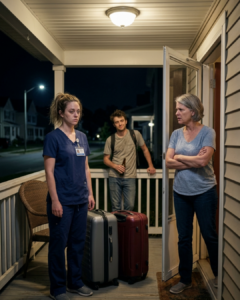
By the time Emily Carter turned onto Maplewood Drive, the digital clock on her dashboard read 11:47 p.m., and the kind of exhaustion that settles into a nurse after twelve hours on her feet had turned her whole body into one long ache. Her lower back pulsed. Her heels felt like they had been beaten with hammers. Her ponytail had loosened somewhere around hour nine, and the smell of antiseptic and hospital coffee still clung to her scrub jacket even though she had changed in the staff locker room before leaving Riverside Methodist. She was thinking only of hot water, silence, and the six hours of sleep she might steal before doing it all again when she saw the suitcases on the porch.
At first her mind rejected what her eyes were telling it. Two navy suitcases and a gray duffel sat in a row beneath the porch light like obedient children waiting for pickup. Hers. The larger one still had the airline tag from a conference in Chicago last fall. The smaller one had a cracked handle she kept meaning to replace. The duffel had faded white paint on one side from when Tyler borrowed it three years ago and returned it with “just a few marks” that turned out to be half a deck stain project.
Emily slowed the car without realizing it, rolled another three feet, then stopped crooked at the curb.
The house rose before her in its usual shape. White siding. Black shutters. The brass wind chime by the front door that her mother insisted made the place look “welcoming.” The mailbox out front leaning slightly to one side because Robert Carter had always said he’d straighten it when the weather turned and then died before the weather did. There was nothing cinematic about the scene. No broken window. No smoke. No flashing lights. Just luggage on a porch and a knowledge so cold and fast it seemed to suck the heat right out of her skin.
The front door opened.
Linda Carter stepped outside with her arms crossed so tightly that her cardigan pulled at the buttons. Even from the car Emily could see that her mother did not look guilty. She looked inconvenienced.
“You’re finally home,” Linda said when Emily got out of the car.
Emily closed the driver’s door carefully because if she slammed it, something in her might start shaking and not stop. “What’s this?”
Linda glanced at the suitcases as if seeing them for the first time, though that performance lasted less than a second. “You’re twenty-five, Emily,” she said. “Stop being a burden and leave.”
The words landed oddly, with so little drama that for one stupid instant Emily almost laughed.
“A burden?”
“Don’t start.” Linda’s voice sharpened immediately, the way it always did when she sensed the possibility of facts intruding on a version of events she preferred. “Tyler needs a place to stay, and we can’t keep carrying you forever.”
Emily stood very still.
Carrying her.
It was almost elegant, the lie. She had been paying one-third of the electric bill for fourteen months because her mother never quite had enough on the due date. She bought groceries twice a week because Linda “forgot” staples in ways that always mysteriously skipped the expensive coffees and beauty products she considered essential. She handled the internet bill entirely because her remote continuing education modules and chart review work required it, and because the idea of relying on her mother for one more monthly responsibility made her chest hurt. She paid for her own car, her own phone, her own scrubs, her own licensure fees, her own life. She also, though no one in the house ever said it aloud, routinely covered the gap between what Linda pretended the household costs were and what they actually came to, because after Robert died there had always been a gap, and Emily had learned too quickly what happened when nobody covered it.
Through the front window she saw Tyler on the couch.
He sat with one ankle over his knee, head bent toward his phone, exactly as if he already belonged there. At the sight of her, he glanced up and gave the smallest smirk, a private flash of smugness that vanished when he realized she was looking directly at him. Then he looked back down again like a man watching the third act of a play he had already read.
That was when the whole shape of it came clear.
This wasn’t impulsive. This wasn’t Linda having some late-night breakdown about bills or boundaries or “motivation,” one of her favorite words whenever she wanted to relabel cruelty as character-building. Emily’s bags had been packed before she got home. Tyler was already inside. They had discussed timing. They had anticipated tears, pleading, maybe yelling. They had built an audience-free version of the scene where Linda could call the decision practical and Tyler could move into her room before sunrise.
Emily looked back at her mother.
Linda must have seen something in her face, because she straightened and added, “Take everything. I don’t want you coming back for anything later.”
The sentence was so final, so prepared, that Emily felt a little laugh rise again, but this one hurt too much to let out.
“Okay,” she said.
Linda blinked.
“Okay?” she repeated, almost suspiciously.
Emily bent down and picked up one of the suitcases. The weight of it pulled against her aching shoulder and made the bruised fatigue in her body flare. “Yeah,” she said quietly. “Okay.”
Linda frowned. “That’s it?”
Emily did not answer.
Instead she pulled out her phone and scrolled to a contact she had not used in months but had never once considered deleting.
Michael Bennett answered on the second ring.
He did not say hello. He said, “Emily?”
That alone almost broke her.
There are adults who survive your childhood because they cared enough about your father to keep an eye on what happened after he was gone. Michael Bennett was one of those adults. He had been Robert Carter’s attorney for more than twenty years, but he had become something more than legal counsel in the years after Robert’s stroke. Not family exactly. Better, in some ways. A man who knew where the paperwork lived and what promises it had been designed to outlast.
“I need a favor,” Emily said.
There was a pause long enough for him to hear the steadiness she was forcing into the sentence and know something serious had happened anyway.
“What happened?”
“I’m outside the house,” she said. She kept her eyes on Linda while she spoke, because her mother had begun shifting from foot to foot now, reading the moment badly and assuming perhaps that Emily had called a friend or coworker to come pick her up. “Can you come here?”
Another pause. Then Michael’s voice changed. Sharpened.
“Stay there,” he said. “Thirty minutes.”
The line went dead.
Emily slid the phone back into her pocket and dragged the larger suitcase down to the curb. The wheels rattled over the cracked walkway, one catching momentarily on a lifted corner of cement before rolling free. She brought the second one down more slowly. Then the duffel.
Linda stayed near the porch, arms folded, watching as though making sure Emily did not sneak back inside for sentimental reasons.
“You’re being dramatic,” she said after a minute.
Emily looked up from the duffel.
“No,” she said. “I’m being gone.”
That seemed to annoy Linda more than if Emily had screamed.
She stepped down one stair. “You always do this. You make me into the villain when I’m trying to help you grow up.”
Emily almost said, I work trauma step-down twelve hours at a time and still buy the eggs in this house, but the words felt wasted. Linda had spent years perfecting a particular kind of maternal revisionism. In her version of every conflict, Emily was difficult, oversensitive, defensive, demanding. Linda was practical. Pressured. Trying her best. If she hurt you, it was because she was under strain. If she asked too much, it was because family required sacrifice. If she crossed a line, it was because you had been cold enough to make her. This logic had carried her through marriage, widowhood, unpaid bills, missed parent-teacher nights, and every sharp sentence she had ever delivered to the daughter least likely to dissolve in public.
Emily had stopped believing it around age fourteen. But not believing a lie doesn’t automatically mean you stop being shaped by it.
At minute twenty, Tyler came to the doorway with a can of soda in one hand.
“You know,” he said, looking down at her suitcases, “if you’d just admitted this place wasn’t really working out for you, it wouldn’t have had to get ugly.”
Emily stared at him.
Tyler was her cousin technically, but families like theirs erased those distinctions whenever it suited them. His mother—Linda’s younger sister, Beth—had burned through men, motels, apologies, and eventual liver failure by the time Tyler was twenty-two. Since then he had drifted through a string of couches, girlfriends, and vague construction jobs, always somehow one misunderstanding away from stability and one debt away from needing “just a little help.” Linda had never been able to resist him. Maybe because he was Beth’s son. Maybe because he was male and vaguely hapless, which in her world still translated to fragile instead of irresponsible. Maybe because taking care of Tyler let her feel generous in ways she had never managed with her own daughter.
“Ugly?” Emily asked.
He shrugged. “You know what I mean.”
“No,” she said. “I don’t.”
Tyler took a long swallow of soda. “Mom said you’ve been acting like this is your house.”
Emily did not even look toward Linda when he said it. She kept her gaze on him. “That’s interesting.”
He snorted. “Don’t start your lawyer voice with me.”
“I’m a nurse.”
“Same energy.”
For one bright second she thought of taking the can out of his hand and smashing it against the porch rail just to watch him flinch. Instead she stood there with her exhaustion and anger braided so tightly they had become almost indistinguishable and said nothing at all.
At minute twenty-nine, a black SUV turned onto Maplewood Drive and pulled up in front of the house.
The engine shut off. The street, which had been carrying the usual late-night suburban noises—someone’s television through an open window, a dog barking three houses down, tires whispering on pavement at the corner—seemed to pull in around the vehicle and wait.
The driver’s door opened.
Michael Bennett stepped out in a dark suit with his overcoat folded over one arm and a thin leather folder in his hand. He moved with the calm velocity of a man who had spent three decades walking into rooms where people mistook money for power and paperwork for a suggestion until he educated them otherwise. He was sixty-one, silver-haired, broad through the shoulders in a way that spoke of a younger life spent outdoors or in service of something harder than law, and he had the kind of face that made dishonesty work much harder for its results.
The moment Linda saw him, she went pale.
That was the first crack in the night.
She came off the porch too quickly, almost stumbling on the last step. “Michael?”
He didn’t look at her at first. He looked at the suitcases. Then at Emily. Then at the house. His expression darkened almost imperceptibly, but Emily saw it because she was looking for it.
“What are you doing here?” Linda asked, voice thinner now. “This is a private family matter. Emily is just… moving out.”
Michael’s gaze settled on her at last.
“Is she?” he asked.
There was no heat in the question, which made it far more dangerous.
Linda’s hands came up in a fluttering gesture that was part explanation, part defense. “She’s twenty-five, Michael. She’s been living here too long. Tyler needs a place. We’re trying to motivate her to stand on her own feet.”
Michael let the silence answer that for one beat, then opened the leather folder and pulled out a single sheaf of papers.
“I remember a conversation with Robert three years ago,” he said. “Actually, several conversations. Mostly about this house. Mostly about what might happen if people started mistaking occupancy for authority.”
Linda’s eyes dropped to the documents and then away so quickly Emily knew she already understood what they were.
Michael handed the first page to her anyway.
“Read the third paragraph,” he said.
Linda’s hands shook.
Emily watched them. She had seen those same hands apply foundation in the rearview mirror, frost sugar cookies, sign school forms, light candles in church, count cash in the kitchen when bills stacked too high. She had also seen them hide receipts, tear up notices, and perform helplessness when facts started asking more of her than emotion could cover. Those hands had shaped much of Emily’s life. Seeing them tremble now did not make her feel cruel satisfaction exactly. It made her feel something sharper and sadder.
Exposure.
Linda read in silence, lips moving. Her face lost color with each line.
“What is this?” Tyler asked from the porch.
Michael answered without looking at him. “This house at 412 Maplewood Drive was never transferred to your aunt. It has been held in a restricted trust for Emily Carter since Robert Carter’s death, with the remainder vesting in full possession on her twenty-first birthday. Your aunt’s right to reside here is limited by the terms of a life estate conditioned on maintaining the house as Emily’s primary residence for as long as Emily chooses it.”
Tyler frowned, not understanding fast enough. “What does that mean?”
“It means,” Michael said, “your aunt does not own this house. Emily does.”
The words sat in the night air like a thunderclap delayed just long enough to grow more enormous in the waiting.
Linda shook her head. “No. Robert wanted me to have a home.”
Michael’s voice lowered. “Robert wanted Emily to have a future. He wanted you sheltered while you chose to behave as her mother rather than her landlord. By packing her bags and forcing her out, you’ve done more than have a bad night, Linda. You’ve materially breached the conditions that allow you to remain here at all.”
Tyler stared from one face to another. “That’s ridiculous.”
Michael finally turned to him. “No, what’s ridiculous is assuming a vulnerable young woman who has been paying bills in this house for years was here on sufferance simply because the person collecting the mail enjoyed pretending she owned everything under the roof.”
Emily almost laughed then, not because anything was funny, but because Michael could cut a person open with paperwork and still sound like a man discussing rainfall totals.
Linda lowered the pages. “I didn’t mean—”
“You packed her bags,” Michael said.
“I was trying to—”
“You put her belongings on the curb after midnight.”
“I just wanted her to learn—”
“What?” Michael asked, and for the first time his voice carried real force. “That the home legally protected for her future could be repurposed for a male relative the moment he needed convenience? That her labor counted only until someone else wanted the bed? That your authority extended to dispossessing the person your late husband explicitly protected against this exact impulse?”
Linda’s mouth opened. Closed.
There are moments in family conflict when one person’s favorite version of herself dies in public. Emily had not realized until that instant how much of Linda’s identity depended on the belief that she was not cruel, merely overwhelmed. Not selfish, merely practical. Not biased, merely maternal. Michael’s words stripped that language off her and left the act standing naked beneath it.
Emily stepped up onto the first porch stair then, closer now, her exhaustion peeled back far enough to reveal something calmer and colder beneath.
“I’m tired,” she said quietly. “I’m tired because I work twelve-hour shifts and come home to cover groceries. I’m tired because the electric bill has been late more than once and I paid it without making you feel ashamed. I’m tired because you’ve treated my paycheck like family glue while calling me a burden. And I’m especially tired of you acting like this house exists because of your generosity.”
Tyler shifted uncomfortably. “Come on, Em.”
“No,” she said, turning to him. “Not ‘come on.’ You sat in that living room like you already owned the place. Did you know?”
He looked toward Linda automatically. That answered enough.
“Tyler,” Michael said, voice mild again, “how much were you told?”
Tyler’s jaw tightened. “Aunt Linda said Uncle Robert left the house to her and Em was just staying here until she got serious.”
Michael let out one humorless breath. “How convenient.”
Emily looked at Tyler’s face—the confusion, the dawning humiliation, the refusal to give up anger even now because anger was easier than admitting he had built his behavior on a lie and a lifetime of entitlement—and knew suddenly what she wanted.
Not vengeance.
Order.
“Tyler,” she said, “grab the navy suitcases.”
He blinked. “What?”
“They’re packed,” she said. “You and Mom can use them.”
Linda stared at her. “Emily—”
“You’re right,” Emily said, and the force of her own composure startled even her. “Adults should stand on their own feet. You’ve been saying that all night.”
Michael watched her closely but did not interrupt.
Tyler gave a short disbelieving laugh. “You can’t just throw us out.”
Michael looked at him. “Actually, under the trust terms and after the breach your aunt has committed, Emily could have the sheriff supervise immediate removal. Tonight.”
The word sheriff seemed to hit Linda in the lungs.
“No,” she said quickly. “No, that won’t be necessary. Michael, please. We can talk. Emily, sweetheart—”
Sweetheart.
The word almost made Emily flinch.
Linda only used terms of endearment under two conditions: when other people were present, or when power was leaving her body too quickly and she needed something soft to slow the bleed.
Emily looked at the house then. Really looked. The porch rail Robert had repainted twice. The brass wind chime. The light in the front hall that had burned out three times in winter because Tyler kept using the wrong wattage bulb and leaving it to her to fix. The kitchen where she had stood paying bills at midnight while her mother talked about “family image” and ordered expensive seasonal centerpieces online. The living room where sympathy had always bent toward the loudest claim. The hallway where her father’s boots had once sounded, years ago, before the stroke took him in stages and then all at once. The place held more than walls. It held the sediment of everything she had survived.
For years she had thought staying there meant loyalty.
Now she saw how close it had come to becoming slow erasure.
“What happens now?” she asked Michael.
He glanced at his watch. “Legally? You are the owner and current occupant. Linda’s breach means her right to remain is contestable immediately. If you want, I can call the sheriff and have them supervise removal tonight. Or you can permit temporary occupancy under your own terms until alternate housing is secured. But the power is yours.”
The power is yours.
Emily heard the sentence twice: once as law, once as something older and more personal. Not because she loved authority. Because she had spent years in a house where every ounce of her effort got translated into obligation while everyone else’s need became emergency.
Linda took one step toward her. “Emily, I was just trying to help Tyler. He’s had a hard year.”
“So did I,” Emily said. “And nobody put anyone else’s suitcases on the porch for me.”
Tyler’s face hardened. “You’re really doing this?”
Emily looked at him and realized, with sudden almost painful clarity, that his entire life had trained him to expect one more reprieve. One more aunt. One more couch. One more woman in the family turning her structure into his landing pad.
“Yes,” she said.
There are thirty minutes in my memory from that night that live with a strange sharpened brightness. Tyler yanking the duffels more roughly than necessary. Linda moving through the house in jerky bursts, taking whatever she could carry while still pretending this was temporary and not a legal and moral collapse. Michael in the kitchen on his phone arranging a locksmith for first thing in the morning and speaking in that quiet efficient tone that made it clear he had already moved three steps beyond everyone else’s panic. Me standing in the doorway to my room while my mother took one final look at the bed, the dresser, the photos on the shelf, as if trying to decide whether enough of the house still emotionally belonged to her to make this count as a misunderstanding later.
She said, “You could let me stay. I’m still your mother.”
And maybe if she had said it differently—if there had been one ounce of recognition in it, one sentence that acknowledged what she had done rather than simply invoking the title as automatic leverage—I might have hesitated.
But I didn’t.
Because motherhood is not a permanent override code.
“Get in the car, Mom,” I said.
Tyler loaded the last bag into Linda’s sedan with the mutinous movements of a man performing exile badly. Before getting in, he turned back toward me.
“You’ll regret this,” he said.
“No,” I answered. “I’ll finally hear myself think.”
Michael waited until they drove away before he let himself exhale fully.
The locksmith arrived at 1:12 a.m., changed the front and side door locks, reset the garage code, and replaced the small keypad battery that Tyler had been too lazy to fix for months. Michael stood in the kitchen while it happened, taking calls and making notes. At one point he opened his folder again and handed me a second packet I hadn’t noticed yet.
“I took the liberty of bringing the full trust file,” he said. “I suspected Robert’s planning might become relevant sooner rather than later.”
I sat at the table with the packet in my lap and finally let my whole body feel how tired it was. “Did you know she’d do something like this?”
He considered. “I knew Robert feared she might.”
That landed.
My father—Robert Carter—had not been a perfect man, and death had not turned him into one. He had loved quietly, too practically sometimes, and left too much emotional labor sitting around unspoken like unpaid invoices. But he had seen things. Not every time, not clearly enough soon enough, but enough. Enough to understand Linda’s tendencies, enough to understand his daughter’s, enough to know what money and shelter meant differently to a woman who would always be asked to hand both over more readily than a man.
“I thought he left everything to her,” Emily said softly.
Michael shook his head. “He left enough appearances in place that she could tell herself that. It was easier while you were young. He wanted her housed, not empowered. There’s a difference.”
I laughed tiredly. “You sound like a cross-examination.”
“I drafted part of the language. I’ll take that as praise.”
When he finally left, it was nearly two. Emily stood alone in the kitchen of the suddenly silent house and listened. No television through the wall. No Tyler stomping around upstairs pretending not to be angry. No mother opening and closing cabinets too loudly because disappointment needed acoustics. Just the refrigerator humming, the ticking wall clock, and her own breathing moving through the rooms as if introducing itself to them properly for the first time.
She walked from room to room before bed.
Not checking for damage.
Claiming.
The hallway. The spare bedroom. The laundry room with the cracked tile. The front room with the lamp she hated and would finally replace. The little square of moonlight by the stairs. The primary bedroom where her mother had arranged furniture the same way for years because change felt like waste to her if it didn’t involve something decorative and expensive. Emily stood in the doorway there longest, not from sentiment but because it was the room where all Linda’s secret claims to power had lived—drawers, creams, jewelry, receipts, the scripts of victimhood she wore under cardigans and perfume. Now it looked smaller. Like any room stripped of mythology.
She slept in the guest room that night.
Not because she was afraid.
Because the main bedroom still smelled like her mother’s lotion and hairspray and she wanted one clean place where the air belonged only to this new fact: she was not being tolerated here. She was home.
The next morning the calls began.
Aunt Susan first, breathless and appalled and somehow already sure she understood more than anyone involved. Then Pastor Reggie’s wife, who absolutely should not have known anything yet unless my mother had begun spinning before dawn. Then Beth’s old friend Marla, calling on Tyler’s behalf as if forty-year-old men now came with public relations support. Every conversation had the same shape. Concern. Confusion. A gentle suggestion that surely something could be worked out because “family is family.”
Emily cut them all off with versions of the same sentence.
“This is a legal property matter, and I won’t discuss it by phone.”
By noon, Linda had shifted tactics.
If midnight had been about force, daylight became about guilt.
Her text messages arrived in bursts.
Linda: I had nowhere else to go last night.
Linda: Tyler is sleeping on Beth’s old sofa. You know his back is bad.
Linda: I’m your mother, Emily. I shouldn’t be treated like a criminal.
Linda: Michael manipulated this.
Linda: Your father would be horrified.
That last one made Emily sit down in the kitchen chair and stare at the screen for a long time.
Your father would be horrified.
No, she thought.
He would be disappointed in both of us.
In you for trying this.
In me for not understanding sooner how carefully he built the protections he knew I’d need.
But she didn’t answer that either.
Instead she took the day off, changed the sheets in every room, made a list of everything that needed doing, and began reclaiming the house in practical ways because practical labor was the one kind of ritual she trusted. She boxed Linda’s remaining bathroom products. Donated three garbage bags of old decorative pillows nobody sat against comfortably anyway. Replaced the lamp in the front room. Moved the ugly brass bowl from the entry console to the donation pile. Opened every window. Let the place air out.
Grief followed her while she worked.
That surprised her, though it shouldn’t have.
Because whatever Linda had done, and however necessary last night had become, losing your mother’s daily presence is still a kind of death when you’ve spent years organizing your movements around it. Even when the presence is corrosive. Even when it should have ended sooner. The body grieves habit too. She cried once while folding an afghan that had belonged to her grandmother because it still smelled faintly like cedar and face powder and because no one in that house had ever once asked whether Emily was lonely carrying so much of it.
By evening Michael called again.
“They’ve retained counsel,” he said without preamble.
Emily stood at the sink washing strawberries and closed her eyes. “Of course they have.”
“David Morrison is petitioning to overturn the trust arrangement. Incapacity, undue influence, ambiguity of intent. The usual family nonsense with a good suit on.”
“Can they win?”
“Not on law. But law and winning are cousins, not twins. They can make it expensive. Exhausting. Public, if they’re foolish enough.”
Emily dried her hands on a towel. “Then let’s make foolish expensive.”
Priya Shah came over that night with takeout, a legal pad, and the kind of clean energy only attorneys who enjoy a good documents fight seem to possess.
She was five-foot-two, wore oversized tortoiseshell glasses, and had once told a landlord’s lawyer in open mediation that his client’s understanding of contract law had “the structural integrity of damp cake.” Emily trusted her more than almost anyone alive.
She sat at the kitchen table under the old pendant light, flipped through the deed packet, the trust language, the life estate conditions, and the texts from Linda and Eric, and said, “Well. This is going to be a bloodbath, legally speaking.”
“That sounds promising.”
“It is. For us.” Priya tapped the page with one neat fingernail. “Your dad was more careful than I expected. Restricted trust. Life estate conditioned on primary residence for the beneficial owner. Clear remainder interest. Good recording sequence. Also, and this is my favorite part, the clause giving the trustee no authority to alter occupancy rights unilaterally once you reached twenty-one. Which means your mother and brother were running on vibes and inherited patriarchy.”
Emily laughed despite herself.
Priya leaned back. “Do you want to let your mom stay as a formal tenant?”
The question hung in the room, heavier than the tone suggested.
Emily looked around her kitchen. The same kitchen where she had stood so many nights paying bills and pretending not to hear Linda on the phone telling friends she was “supporting Emily while she figures things out.” The same kitchen where Tyler had once eaten a week’s worth of groceries in three days and then complained there was never anything good in the house. The same kitchen where her father used to stand, tired and kind and too conflict-averse for his own intelligence, slipping her grocery money in an envelope and saying, Don’t tell your mother. The same kitchen where she now stood with legal proof in a folder and a choice no daughter should have to make if the people around her had loved her cleanly enough.
“I don’t know,” she said.
“That’s a real answer,” Priya replied. “Just don’t confuse mercy with re-entry.”
They prepared for war.
That is the truth of legal conflict inside families—it is war waged in paper cuts and calendars and memory. There are no battlefields, not obvious ones. Just conference rooms, affidavits, records requests, word choices that either become walls or doorways depending on what kind of future you think might still be possible.
David Morrison’s lawyer came in expensive and confident, which Emily expected. Men like her father always paid for polish when they needed reality translated into something they could once again feel in charge of. The petition argued that Grandpa Joe—Joseph Morrison in the documents—had been elderly, perhaps influenced, perhaps not fully aware of the consequences of his transfer structure. It leaned heavily on “family intent,” which was not a legal doctrine but remains a reliable emotional narcotic in these disputes. It implied Emily had benefited from proximity, from secrecy, from being “favored” unfairly. It suggested the building had always functioned as a family asset and should continue doing so under David’s stewardship.
The first time Emily read the filing, she laughed.
The second time, she got angry.
By the third, she understood what hurt most: not that they were trying to take the property, but that they were so certain she would still occupy the same role even in court. The role of the daughter expected to back down once men with folders arrived. The one who would care more about appearing cruel than about being dispossessed. The one who could be made to feel guilty for insisting on what was legally, practically, and morally hers.
They had not noticed that the years had changed her.
Court dates were set. Statements exchanged. Discovery requests sent.
Eric avoided her entirely except when the process required otherwise, and then he wore the expression of a man forced to participate in an absurd charade. Shannon grew quieter with each meeting. She once showed up to a deposition with dark circles under her eyes and said in the hallway while her husband was in the restroom, “I told him not to go into the apartment.” It wasn’t an apology. It was perhaps the edge of one. Emily nodded once and let her keep what dignity she could.
Her mother cried in every procedural room.
At first Emily thought it was performance. Then she realized it was not that simple. Linda’s tears were real. So was her self-pity. Those things often coexist. She was losing not only the house but the version of herself that had lived there unquestioned, the widow protected by circumstance, the mother who could still direct traffic through the rooms of her life without asking what right she had to the map.
Her father said very little outside formal proceedings.
That, more than anything, told Emily how badly he knew he had miscalculated.
He had built his authority over a lifetime on certainty and tone. If he no longer trusted either, silence was all he had left that still looked like choice from a distance.
The day of the hearing arrived in late February under a gray cold sky that made the courthouse seem even more severe than it already was. Emily dressed carefully—not to impress, but because putting on the right suit before a fight still felt like sharpening a blade. Navy wool. White blouse. Hair back. Minimal makeup. Small gold studs. She looked, Priya said when they met outside the courtroom, “like the worst possible surprise for men who expected a frightened daughter.”
Inside, the room was wood-paneled and overheated. The judge, a woman in her sixties with silver hair and the exact expression of someone who had seen enough inheritance fights to believe all adult children revert a little around property, took the bench with no appetite for wasted time.
David’s attorney led first, as expected.
He spoke of legacy, of grandfatherly intent, of family stewardship. He spoke of a son who had long managed the property’s practical realities. He spoke of a daughter who had benefited from a “special arrangement” and now refused to share the burden of family need. He invoked Shannon’s pregnancy twice in ten minutes, which Priya wrote something on her legal pad after the second time and then turned it so Emily could read it.
He thinks uteruses are legal arguments.
Emily nearly smiled.
Then Priya stood.
She did not raise her voice. She didn’t need to. She walked the judge methodically through the trust language, the recording dates, the transfer on death deed, the absence of any legal basis for David’s claimed authority, and the life estate provision Linda had violated when she attempted to remove Emily from the home. She submitted texts, the police incident report from Eric’s break-in, and the locksmith invoice with the dry competence of a woman who enjoys watching sentimental nonsense meet authenticated exhibits.
The judge asked sharp questions. Priya gave sharp answers.
Then David himself took the stand.
Emily had not seen her father on the stand since she was eight years old and he testified in a minor accident case where a delivery truck hit his car. Even then he had looked comfortable in public narration, confident that facts, if arranged well enough, would naturally come out respecting him. Now he sat there beneath the courthouse lights, one hand flat on the witness rail, and tried to explain how his father “would never have wanted one child elevated above the others.”
“Then perhaps,” the judge said mildly, “you can explain why he signed a deed doing exactly that.”
David shifted. “My father could be impulsive.”
Priya stood. “Your Honor, may I direct the court to Exhibit 14?”
The judge nodded.
Priya handed up the document. “This is a letter recovered from Joseph Morrison’s safe deposit box and authenticated this morning by his long-time attorney and handwriting analysis, dated two months before his death.”
My father closed his eyes.
That was the first time he looked truly beaten.
The judge adjusted her glasses and read aloud.
“I am leaving the Westbrook property to Cassandra. My son, David, has spent his life trying to please everyone by giving away things that aren’t his to give. My grandson, Eric, has never worked for a roof over his head. I leave the building to the only person in this family who understands that a home is earned, not assigned.”
The silence afterward felt surgical.
My father’s face changed in real time.
Not only because he lost. Because Grandpa Joe had reached out from death and named the exact flaw he had spent a lifetime dressing up as generosity. Softness. Peacekeeping. The reflex to offer others whatever wasn’t nailed down if it bought him temporary relief from discomfort. In private, that habit had looked like compromise. In legal language, under oath, it looked like disqualification.
The judge set the letter down and looked directly at him.
“The deed stands,” she said. “The petition is denied in full. I further find this litigation frivolous in light of the clarity of the transfer documents and the corroborating evidence submitted. Mr. Morrison, you will be responsible for Ms. Morrison’s legal fees.”
My father’s shoulders seemed to collapse all at once, though he never slumped visibly. My mother covered her mouth. Eric said something vicious to Shannon in a whisper and she recoiled from him as if finally, finally seeing the man she married without the insulation of family fantasy.
I sat still until the judge left the bench.
Only then did I let myself exhale.
Outside the courthouse, my mother caught up first.
“You didn’t have to destroy us,” she said.
I turned and looked at her, this woman who had stood on a porch and told me to stop being a burden while using a house she did not own as leverage over the daughter who had kept it running.
“I didn’t destroy anything,” I said. “I just stopped pretending your version was the truth.”
She cried harder at that, but there was no accusation left in it. Only collapse.
My father came out last.
He stopped three feet from me, hands at his sides, the courthouse wind flattening his coat against his frame. For a second I thought he might say something defensive, or grand, or belatedly fatherly.
Instead he said, “He knew me too well.”
I looked at him and understood that he did not mean me.
Grandpa.
“Yes,” I said.
He nodded once. No argument. No rebuttal. Then he walked past me down the steps, and in that moment he looked older than he ever had before—not frail, not broken, just suddenly relieved of a version of himself he no longer had the strength to keep performing.
The weeks after the ruling were quieter than I expected.
Not peaceful, exactly. There was paperwork to finalize, fees to settle, notices to update. Priya made sure every legal angle was locked down so tightly no future family nostalgia could slip a hand through the frame. Michael helped with trust closure language and transition formalities. The life estate was terminated. Linda and Tyler signed acknowledgment forms through counsel. The house became mine in the cleanest, ugliest way possible: through proof, conflict, and judgment.
I let Linda stay in a rental condo for three months through a small stipend Michael said Grandpa had quietly funded in a separate account specifically to prevent “your mother from turning destitution into a moral argument.” That phrase sounded exactly like him. I paid the final month myself after the account ran out, not because she deserved it, but because I wanted to know my own choices were clean even when hers hadn’t been.
I did not invite her back.
People asked if I regretted that.
Some relatives whispered that I had become hard. Others said they admired me in the slightly frightened tone reserved for women who finally refuse the role of family shock absorber. A few friends asked honestly, wanting to understand whether there had been room for another path.
Maybe there had been. In some gentler universe where midnight betrayals didn’t happen on porches and grown men didn’t let themselves into women’s homes because their father said it was fine. In some world where apology arrived before litigation and accountability wasn’t dragged out by the hair. But we had not lived in that world. We had lived in this one.
Here, a second chance would not have been mercy.
It would have been re-entry.
And I had already spent too many years carrying other people’s weight under the name of family.
Still, I thought about it.
Some nights, sitting in the second bedroom that had once been my office and was now slowly becoming something softer, I asked myself whether I had become too exacting. Whether the silence in the house was sweet because it meant peace or because it meant I had finally arranged things so no one else could ask anything of me.
Then June would arrive with her baby and fill the room with burp cloths and exhausted laughter. Priya would stretch out on the foldout bed after missing the last train and say my guest room had better energy than every luxury hotel in the county. My friend Malik from work would crash on the couch after a breakup and spend an hour helping me choose paint colors for the hallway because apparently heartbreak had made him extremely opinionated about undertones. And I would look around at the people who handled my life carefully and understand the difference.
The room had not become empty.
It had become intentional.
That, I think, was the real inheritance.
Not the building itself, though I loved its brick stubbornness and its old bones and the way winter light fell across the front stair. Not the equity. Not even the legal victory.
The inheritance was the right to decide who crossed my threshold and under what terms.
The right to stop confusing guilt with generosity.
The right to let home mean something other than endurance.
I painted the second bedroom a warm pale yellow the spring after the ruling. Not nursery yellow exactly. Something softer, quieter. I kept the desk by the window for workdays. Added a proper guest bed instead of the old futon. Bought one good armchair and a lamp with real light instead of the dim little task thing I’d used for years. On the shelf by the crib June left behind after her daughter outgrew it, I put three children’s books Grandpa Joe had once read aloud to me when the building still belonged to him and I still believed adults always understood what they were protecting.
Maybe that was sentimental.
Maybe I had earned a little.
Eric never apologized.
Not really.
He sent one text, months later, that read: You made your point.
I did not answer.
Shannon left him the following year. I heard it through the same aunt network that had once tried to shame me into compromise. Apparently there were debts. Apparently there had always been debts. Apparently some men only look stable while someone else is covering the floorboards under them. I thought of writing to her once, not to rescue, just to say I had been where she was standing: beside a man convinced the world owed him softness while he offered none. In the end I didn’t. Her life was hers to name.
My mother and I found a narrow, uneasy version of contact after about eighteen months.
Phone calls about weather.
Holiday cards.
One lunch in a diner near her new condo where she admitted she had not realized how much she’d depended on me until the house went quiet without my labor in it.
“I thought you were just… there,” she said.
I stirred my coffee and let the sentence sit between us.
“That was the problem,” I told her.
She cried then, because she always cried when truth arrived without enough furniture around it. But this time she didn’t ask me to comfort her. She just let the tears happen and then wiped them away and said, “I know.”
That was progress.
My father died before we ever found out what full reconciliation might have looked like.
A heart attack, quick and ordinary, on a golf course outside Dayton two and a half years after the ruling. When I got the call, I stood in my kitchen holding a bag of groceries and felt grief move through me in a shape I still don’t fully know how to describe. Not pure sorrow. Not relief. Something like the end of weather you had learned to dress for so completely that you forgot how much of your body was organized around anticipating it.
At the funeral, Michael stood beside me.
He handed me a small envelope after the service, saying only, “Your father left instructions.”
Inside was a note in my father’s rigid, overcontrolled handwriting.
I was never angry that you were strong. I was angry that strength made you less governable than I knew how to love. I hope you do better with whatever remains of me in you.
I read it once.
Then I folded it and put it in my purse and spent the rest of the afternoon receiving casseroles and condolences from people who had no idea what precise architecture had actually collapsed.
Sometimes I think about that note when I’m unlocking the front door after work.
I still live at 412 Maplewood.
The crooked mailbox finally got straightened.
The brass wind chime remains, though I hated it for a year on principle.
The kitchen tiles are still chipped in two corners.
The guest room is still painted yellow.
The front room lamp is no longer ugly.
The silence is still sweet.
Not because no one can enter.
Because no one enters by theft.
That’s the difference.
Home, I learned, is not whoever says they’re letting you stay.
It is not obligation disguised as generosity.
It is not a roof handed around according to who is loudest or neediest or most socially approved in a given season.
Home is what holds when other people decide your life should become negotiable.
Home is what remains yours even after the family meeting ends and the U-Haul is “booked” and the group chat fills with little heart emojis pretending coercion is kindness.
Home is what you defend not because you love property more than people, but because some people only learn boundaries when walls start refusing them.
When I walk up the checkerboard hall now and hear my own key in the lock, I sometimes think of Grandpa Joe saying roofs are earned, not assigned. At twenty-four I thought he meant money. At thirty-four I thought he meant legal title. Now I think he meant something bigger and meaner and truer.
A home is earned every time you stop handing it to people who only love what they can take from it.
That was the lesson.
And if the house is quieter now, if the rooms finally feel large enough for breath and work and sleep and chosen people instead of inherited obligation, then maybe that’s not hardness after all.
Maybe that’s what peace sounds like when it finally belongs to you.
THE END.
News

“My Sister’s 11-Year-Old Son Spit In My Plate,” he smirked, “Dad Says You Deserve It.” The whole table saw it—my parents kept eating, my brother looked proud. I didn’t argue. I just stood up and left. That night he texted: “You’re not welcome here anymore.” I replied: “Neither is my money. Payments stop at dawn.” By 6 A.M., he was outside my shop screaming—then at 2:04 A.M., the fire alarm went off… and my hidden camera caught who did it.
I never imagined an eleven-year-old spitting in my food would be the least shocking thing that happened that night. When people ask why I don’t go to family gatherings anymore,…

“When My Son Went Into Emergency Surgery, I Texted My Family, ‘He’s Critical—Please Come.’ They all read it. Nobody showed up. For 14 days, I sat alone beside his ICU bed while he fought sepsis. Then, just as he was finally coming home, my phone exploded: ‘Call us now!’ I said nothing. Three days later, I played their voicemails—mortgage bounced, car repossessed, chemo at risk—and smiled coldly, because they had no idea what I’d canceled from that hospital chair…”
The call came at 3:00 on a Tuesday afternoon, the kind of ordinary hour that usually passes without leaving any mark on your life. I was at my desk, halfway…
“I Was Dying at 16,” the ER nurse told my mom. She didn’t rush in—she sighed from a spa chair, cucumbers on her eyes: “If she doesn’t make it, call me later.” The trauma room went silent. My little sister snapped a screenshot of me bleeding on the bed and texted it: “Finally, some peace.” I said nothing—until the hospital called my grandfather. Sixteen minutes later, he burst in wearing fishing boots… and everything changed….
Before I tell you what happened, I need you to step into my body for a minute—into my age, my fear, my exhaustion. I need you to feel how sixteen…

“This year, we’re only inviting your sister’s family!”, Mom texted. I replied right back: “Enjoy yourselves, then”… After I refused to host them for a big Thanksgiving dinner at my house, my father smashed my front window and seized me by the throat hard, snarling, “You think you’re better than us?” My sister kicked me in the ribs, adding, “Some people just need to remember their place.” But …
My name is Claire Whitman, and if you had asked anyone in my hometown who the “good daughter” was ten years ago, they would have said my sister, Megan, before…

“We’re selling the beach house,” Dad declared at my birthday brunch, grinning
The morning of my thirty-fourth birthday started with the kind of lie you tell yourself because it’s easier than facing what your gut already knows. “It’s just brunch,” I muttered…
“Walk Yourself,” My Mom Laughed—She Stopped Smiling When The Mayor Stood Up For My “Nobody” Husband
“Walk Yourself,” My Mom Laughed—She Stopped Smiling When The Mayor Stood Up For My “Nobody” Husband I was eight years old when I first imagined my wedding. Not in the…
End of content
No more pages to load